

You found a recipe you loved, made it your own, and now you’re ready to publish it. But then you start wondering: should you credit the person who came up with the recipe, and if so, how should you phrase it?
If you’ve searched this before, you’ve probably seen a mess of mixed advice. Some people say change three ingredients and it’s yours, while others act like mentioning another recipe at all is risky.
Thankfully, the truth is much more practical. There’s what copyright law may require, and there’s what good etiquette in the food blogging space looks like. We want to make it as simple as possible for you.
📓A quick note… This is general information, not legal advice. If you need guidance for your specific situation, it’s best to speak with a qualified attorney!
What is recipe attribution?
Recipe attribution means giving credit to the source that helped shape your version of a recipe when you publish it. That could be a short note in your introduction, a credit line in your recipe card, a link to the original source, or a mix of all three.
This usually comes up when you find a recipe in a cookbook, on a food blog, or on social media, then make a few changes. Maybe you swapped ingredients, adjusted quantities, changed the method, or rewrote the instructions in your own style. Now you’re left wondering how much credit you should give.
A lot of the confusion happens because two different things are being discussed at the same time.
One is copyright law, which is often more limited than people assume.
The other is food blogging etiquette, where expectations around giving credit are usually higher.
You’re trying to work out both what you legally need to do and what feels fair, respectful, and professional.
What copyright protects in a recipe
Not every part of a recipe is protected in the same way. Some elements are treated as factual or functional, while others can qualify as original creative work. This difference matters if you’re adapting a recipe and wondering what you can reuse, what you should rewrite, and where credit comes into play.
| Recipe component | Protected? | What this means for you |
| Ingredient list | No | Anyone can use the same list. The U.S. Copyright Office generally treats ingredients as facts. |
| Headnote (personal stories, history) | Yes | Your personal intro, family memory, or peach market story is original writing. |
| Narrative instructions | Yes, if expressive | Detailed wording that explains texture, aroma, or technique may be protected. “Bake for one hour” likely is not. |
| Photographs / video | Yes (separate copyright) | The image belongs to the photographer, even if it shows a common recipe. |
| Cookbook as a collection | Yes | The full selection and arrangement of recipes in a cookbook can be protected, even if single ingredient lists are not. |
The difference is usually between an idea and the way that idea is expressed. No one owns the concept of chocolate chip cookies. But a unique written method, personal storytelling, or original photos can be protected.
Courts have reflected this too. In Tomaydo-Tomahhdo, LLC v. Vozary, the court found the recipes in question did not show enough originality to qualify for copyright protection.
Things to really think about here are rewriting instructions in your own voice and taking your own photos creates new original material. That still doesn’t answer whether you should credit the source, which is where legal rules and community expectations begin to separate.
The “three ingredients” rule isn’t real
Somehow, food blogging ended up with its own version of an urban legend: change three ingredients and the recipe is yours. It gets repeated all the time because it sounds helpful. Clear rule, easy math, no awkward decisions. The problem is that it isn’t an actual legal standard.
This idea is often linked to The Recipe Writer’s Handbook by Barbara Gibbs Ostmann and Jane L. Baker. What the book discusses is making three major changes as a publishing guideline, not a legal shortcut to ownership. That’s a very different thing.
And even that misses the bigger picture.
There is no official ingredient counter where changing garlic, paprika, and milk suddenly unlocks ownership status. Ingredient lists are generally not protected the way people think, so using a numbers test doesn’t make much sense in the first place.
What usually matters more is whether the recipe has been meaningfully reworked. Major changes could include:
- Turning a braised dish into a roasted one.
- Changing the core fat or main ingredient in a way that affects the result.
- Restructuring the recipe into something noticeably different.
Minor changes are usually things like:
- Adding extra cinnamon.
- Using flaky salt instead of table salt.
- Reducing sugar a little.
Sara Hawkins has also stated that percentage-change or ingredient-count rules have no legal basis.
The sensible approach is to stop counting ingredients. Ask whether you actually created your own version, rewrote it in your own voice, and whether crediting the source is still the right call. That question, whether you should credit the source, actually has two answers depending on which frame you apply.
Legal requirement or professional courtesy?
This is where recipe attribution gets confusing. People often talk about legal rights and blogging etiquette as if they are the same thing. They’re related, but they are not identical.
Track one: the law
In many cases, if you take inspiration from a recipe, change ingredients, and rewrite the method in your own words, you’ve created something new.
There is usually no automatic legal requirement to credit someone for:
- An ingredient list.
- A broad recipe concept.
- A common dish or technique.
- Your own rewritten instructions based on your own process.
That also means lawsuits over ordinary recipe adaptation are far less common than people assume. Legal issues are more likely when someone copies expressive text word-for-word, republishes photos, or lifts large portions of original content.
Track two: the community
Food blogging runs on trust, relationships, and reputation. That’s where community standards often go further than the legal minimum.
The International Association of Culinary Professionals Code of Ethics requires members not to knowingly use or appropriate any recipe or other intellectual property belonging to another for their own financial or professional advantage without proper recognition.
Even outside formal organizations, many readers and creators expect transparent credit when a recipe clearly came from someone else’s work.
A recent example came in 2025, when Nagi Maehashi of RecipeTin Eats publicly accused Brooke Bellamy of plagiarizing recipes. The fallout included backlash, criticism, and commercial consequences before any court ruling was involved.
For most bloggers, reputational damage is the biggest risk. A lawsuit may never happen. Losing trust with readers, peers, or brand partners can happen quickly and be much harder to fix. That’s why the smart standard is usually higher than the bare legal minimum. If someone’s recipe clearly shaped your version, giving fair credit is often the best move.
Attribution phrasing for every common scenario
Most recipe attribution decisions fall into four buckets:
- Adapted from: Your version still closely resembles the original recipe.
- Inspired by: You made meaningful changes, but another recipe was the starting point.
- No attribution needed (heavily adapted): The final recipe is genuinely your own version.
- No attribution needed (common recipe): Standard recipes with many near-identical versions, like basic vinaigrette or pie crust.
If you’re unsure, leaning slightly more generously with credit rarely hurts.
| Scenario | What to write | Notes |
| Adapted from a blog post | “Adapted from [Recipe Name] by [Author] at [URL]” | Link to the exact recipe page, not the homepage. |
| Adapted from a cookbook | “Adapted from [Recipe Name] in [Book Title] by [Author]” | If linking online, use the publisher or retailer page. |
| Heavily modified recipe | “Inspired by [Author]’s [Recipe Name]” | Good when the original sparked your version, but the result is clearly different. |
| Translated from a foreign-language source | “Adapted from [Original Title] by [Author Name]” | Include the original-language title if possible so readers can find it. Translation still relies on someone else’s work, so credit is expected. |
| Family recipe, source unknown | “From a family recipe” or “Traditional recipe, source unknown” | Name the relative, region, or tradition if you can. |
| Common-knowledge recipe | No attribution needed. | Think classic pie crust, pancakes, or vinaigrette-style formulas found everywhere. |
| Using someone else’s photo | Credit alone is not enough. | You need permission or a license from the photographer. Attribution does not replace permission. |
A few quick examples:
- “Adapted from Classic Banana Bread by Jane Smith at example.com”
- “Inspired by Maria Lopez’s chickpea stew”
- “From my grandmother’s apple cake recipe”
Where should this go?
- In your intro or headnote for readers.
- In recipe notes.
- In your recipe card source field if your plugin supports it.
If you use WP Recipe Maker (like 50,000+ others!), you can add source attribution directly inside the recipe card, which keeps your credit consistent across every post.
Does attributing your source actually help your SEO?
Attribution is often framed as something you have to do. In practice, it can also improve the quality of your recipe post.
The first benefit is your headnote or intro. If you credit the source and explain what you changed, you’re adding original text that no other site has.
For example:
- Why you reduced the sugar.
- Why you swapped ingredients.
- How your version cooks faster.
- What result readers should expect.
That kind of context helps readers, and it gives search engines unique content to understand your page.
The second benefit is structure.
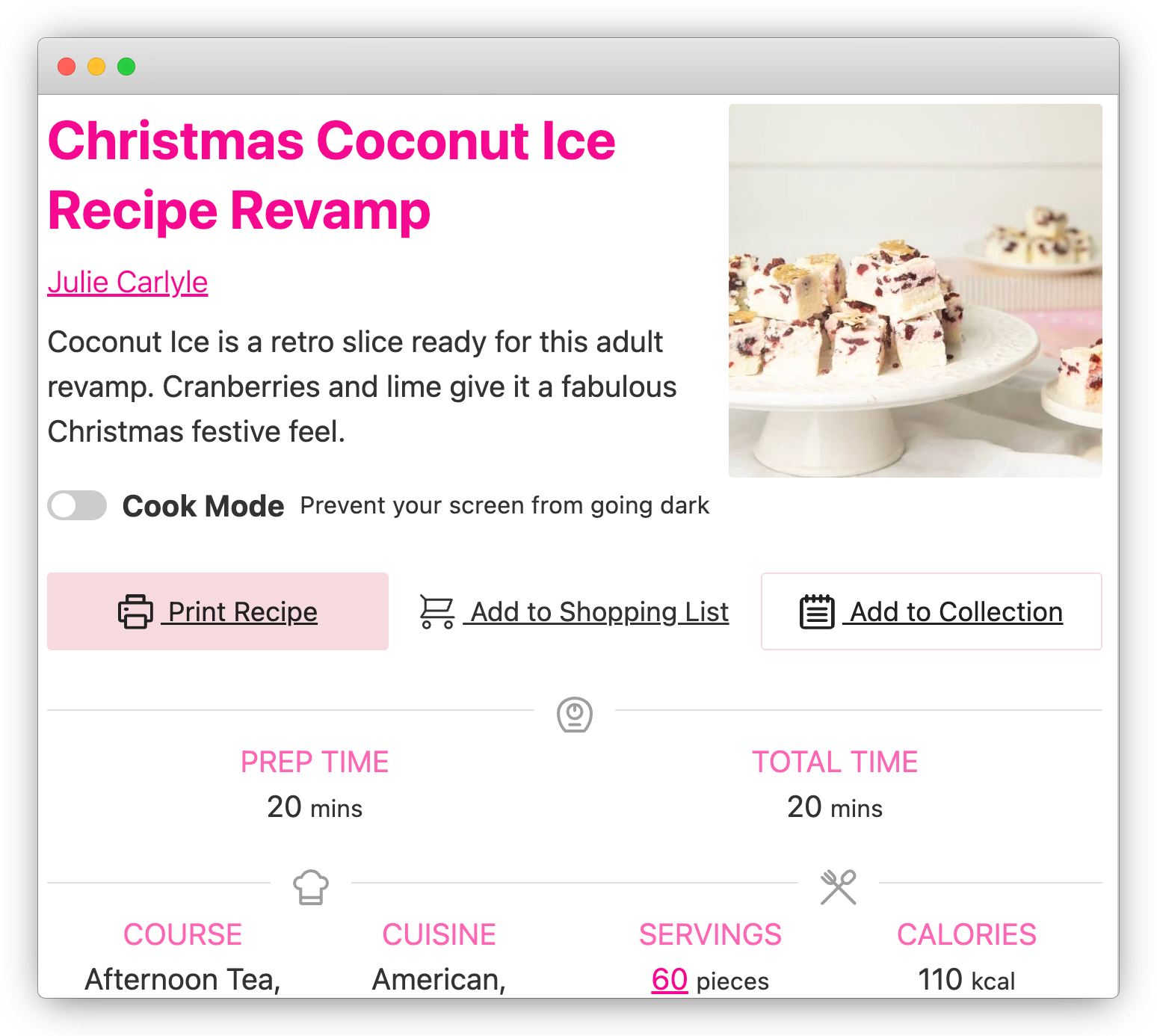
Recipe cards can output structured data, often called JSON-LD. This is the behind-the-scenes code that helps search engines understand recipe details like ingredients, cook time, ratings, author, and publisher. It also helps identify your page as the published version of your recipe post.
The best setup is to place attribution in two spots:
- Headnote or intro for readers.
- Recipe card source / author fields for clean structured data.
If you use WP Recipe Maker, this is easy to manage. Its author attribution fields let you credit original sources directly inside the recipe card, so every recipe uses a consistent format. That feature is available in Premium bundles and above.
It also automatically outputs recipe JSON-LD, so even a basic setup helps search engines properly read your content.
So no, linking to another source won’t magically boost rankings on its own. But thoughtful attribution can improve originality, clarity, and site structure – all things that support stronger recipe SEO.
Publish your recipe today
You probably know more than when you started reading.
You know that copyright protection is narrower than many people assume. You know community expectations are often higher than the legal minimum. And you know exactly what to write based on your situation.
That means you don’t need to keep second-guessing every sentence before publishing.
Pick the attribution phrase that fits, add it to your headnote or recipe card, and move forward.
If you’d like an easier way to handle source credit on every post, WP Recipe Maker includes author attribution fields inside the recipe card, so you can keep everything clear and consistent.
FAQs
Can I get sued for copying a recipe’s instructions word-for-word?
Potentially, yes. Ingredient lists are treated differently from written instructions, and copying expressive text word-for-word creates the clearest risk. If the instructions include original language, storytelling, or distinctive phrasing, republishing them without permission can create copyright issues.
The safer route is to test the recipe yourself and rewrite the method fully in your own voice.
Can I use a photo from another food blogger if I give them credit?
No. Giving credit does not give you the right to use someone else’s photo.
Photographs have their own copyright, separate from the recipe itself. That means you need explicit permission, a valid license, or a source that clearly allows reuse.
If you don’t have that, take your own photos or use properly licensed images instead.